

How To Use Templates For Craft
It is a known fact that WordPress controls 63% of the CMS manufacture. Introducing a new CMS in this tough market is a risky move, simply Brandon Kelly had different ideas. His team developed a CMS system that got huge praise from the users – today y'all may know it as Arts and crafts CMS. In this article, I'll walk you through the Craft CMS and how it works, and finally, I'll discuss how yous can create Arts and crafts CMS Templates for your website.
- Introduction
- What is Craft CMS?
- How Craft CMS Works?
- Entries, Sections & Fields
- Templating in Craft CMS
- Decision
What is Craft CMS?
Craft is designed to provide a consummate digital feel to content creators, developers, and front end-stop designers. The main feature that makes Craft CMS stand out is the flexibility it offers to the developers. The website development can be scaled to accommodate all application functionality. Craft CMS offers a range of advanced dev features to streamline the web development procedure.
Craft CMS hosting is considered to be a cistron that is catered past a few leading hosting solutions providers equally the new CMS required proper installation environments and associated variables.
Craft CMS is powered by PHP v7.0 and to a higher place and is built on top of the Yii2 framework. Arts and crafts CMS templates tin be built using the Twig templating engine.
How Craft CMS Works?
Craft CMS has ditched the traditional CMS systems that come up with pre-built themes, CSS frameworks, and ready-to-go page templates. Equally a result, developers have a bespoke solution to build tier solutions. Craft CMS neither offers pages or posts or any themes and bootstrap features to build the frontend.
If you are new to Arts and crafts CMS, you lot might observe it difficult to work with this idea. However, you lot will before long understand the essence of clean state systems, where you can build anything on your own and customize solutions with a combination of HTML, CSS, and JavaScript (React and Vuejs also).
If at that place is no folio/post like structure, then how tin developers build sites using Craft CMS Theme/Websites? Bank check out some of the building blocks yous need to know about.
Entries, Sections & Fields
Permit's mention the Entries first with some examples for clearer understanding.
Entries are like buckets that hold content data you want to display on a website. Y'all can add multiple entries for property different content sets and reuse them on web pages. Too, the Entries comprise the author's proper noun, status, and content that you add. Each entry has a separate URL; hence, you can fetch any entry with simply the URL. You can assign URL to entries as per the site requirements.
The typical URL of entry looks like this: {{ author.username }}/{{ slug }}

Y'all can divide the whole web folio into different entries similar featured images, paragraphs, sliders, product features, etc. Now, where and how can y'all show these entries?
Before creating entries, y'all must create the Sections to concur them. Each Section can hold multiple Entries (with or without URLs) with an attached template. But, how many Sections can you employ with Craft CMS? There are 3 types of Sections:
i- Singles: Used for pages similar Home Page, Near, and Contact The states page.
ii- Channels: Used for the streams of similar content, such as a Section showing related blogs.
3- Structures: Used for storing and organizing multiple entries into a specific guild.
Some other pregnant features you demand to consider:
Fields: Inject custom information and can be assigned to content
Categories: Allow yous to add together taxonomies for the entries, users, and assets
Assets: Manage documents and media files or any uploadable file
Searchable: All elements can be indexed and automatically searchable
Routing: To check the incoming asking and return a response with twig templates.
Templating in Arts and crafts CMS
Like other PHP frameworks, Craft CMS also uses Twig for templating because of the consummate control over the HTML lawmaking. Note that when you execute the staging URL in the browser to access the Craft CMS site, the template shown will be index.html, which will come up from the /templates folder.
Yous tin can create multiple Craft CMS templates using Twig. Let's say, you can create a folder called features and within it create a file chosen cloudways.html. Yous can add some HTML code to it and access it in a browser like http://mycraftsite.com/features/cloudways.html. Yous can see the HTML layout there. You might have a question: how can I bear witness entries in the browser? For this, you need to work with dynamic URLs.
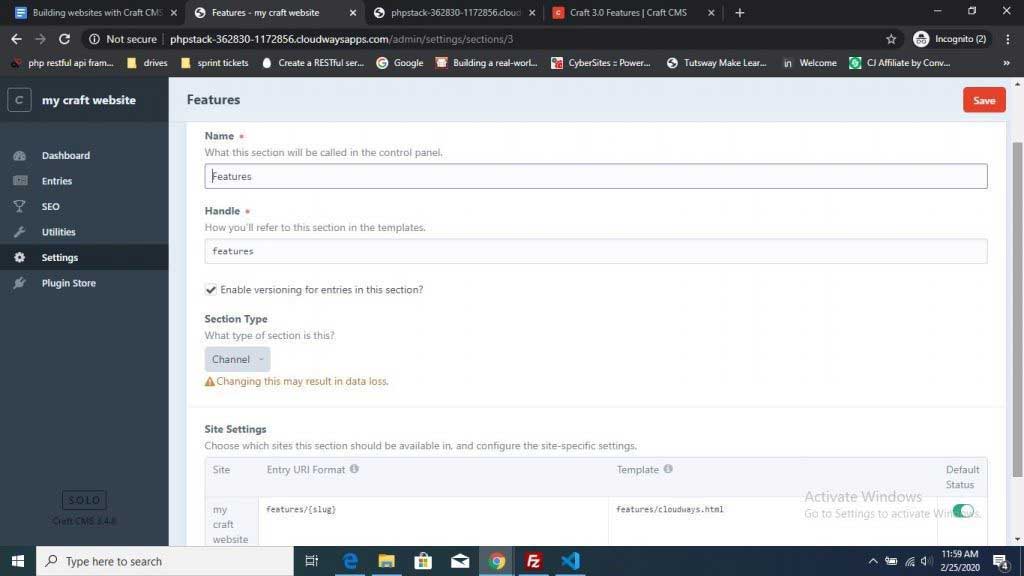
First, you lot need to create a section named Features. As you are non creating a complete page but a content section, you lot can set Section Type -> Aqueduct. At present, in the site setting section, the Entry URL Format will be features/{slug}, and then finally in the template section, you will call the template that is: cloudways.html
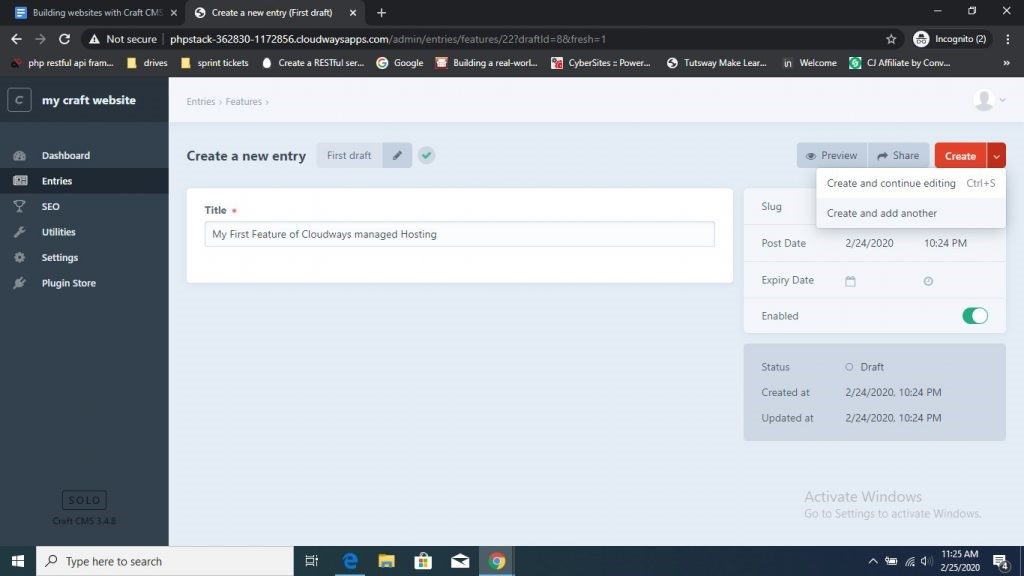
Let'south put some content entries like titles and assign them to the Features section. Open the Entries tab from the left panel and click create a new entry. From the dropdown, select features/{slug} to ensure that the template looks like features/cloudways.html.
Now, let's create another content entries and assign them to the Features department. Click the Entries tab on the left panel, click Create Entry, and select Feature from the driblet-downward menu. You volition see the Create New Entry folio, enter the Championship, and notation the slug created on the right side. Relieve the entry.
Now open cloudways.html file from templates and add the following Twig code adding entry title attribute for getting the title content.
<h1>{{ entry.title }}</h1>
In the browser, type the post-obit URL:
http://app-url/features/my-first-characteristic-of-cloudways
You will see the entry title content on the browser. Change the slugs and check all entries.
This is the basic templating mechanism for Sections and Entries in Craft CMS. Yous can discover this in more details on official Arts and crafts CMS templating docs.
Q: What is TWIG?
A: Twig is a powerful open-source template engine for PHP. The syntax used in Twig originated from Jinja and Django templates.
Q: Does Craft CMS offer Pre-Built Templates?
A: No, Craft CMS does not take pre-built spider web templates. You will have to apply Twig – Template Engine for custom template development.
Q: Does Arts and crafts CMS offer Developer support?
A: Yep, Arts and crafts CMS offers Complimentary and Premium developer support depending on your needs and telescopic of work.
Q: Does Craft CMS support earlier versions of PHP i.e. 5.6?
A: No, Craft CMS is powered past PHP vii.0 and is built using Yii Framework.
Conclusion
In this article, I've discussed the details about what is Craft CMS and how it is different from traditional CMS, and how Twig is the reply to build the Craft CMS Templates as you wouldn't find any pre-built Arts and crafts CMS themes and templates. With Twig, y'all volition have the freedom to create a template the way you want.
If y'all are planning or getting started with Craft CMS, consider the Cloudways Platform and leverage the best cloud hosting environs for your projects without worrying about server management or performance.
If you have any further questions or queries regarding this article, delight feel free to ask them in the comments department beneath.
Share your opinion in the comment section. COMMENT NOW
Share This Article
Customer Review at 
"Cloudways hosting has one of the best client service and hosting speed"
Sanjit C [Website Programmer]

Umer Jalil
Umer Jalil is a Digital Content Producer at Cloudways. He is passionate about digital marketing and the latest happenings in the tech world. He is an avid gaming enthusiast from heart and loves playing Cricket in happy hours!

How To Use Templates For Craft,
Source: https://www.cloudways.com/blog/using-craft-cms-template/
Posted by: collinshickinurpoll.blogspot.com
0 Response to "How To Use Templates For Craft"
Post a Comment