

Should I Manually Adjust Shareholder Draws Account And Owner's Equity Account At End Of Year
Introduction to Financial Statements
x Prepare an Income Argument, Statement of Owner'due south Equity, and Balance Sail
One of the key factors for success for those get-go the written report of accounting is to understand how the elements of the financial statements relate to each of the fiscal statements. That is, once the transactions are categorized into the elements, knowing what to do next is vital. This is the beginning of the process to create the financial statements. It is important to annotation that financial statements are discussed in the order in which the statements are presented.
Elements of the Financial Statements
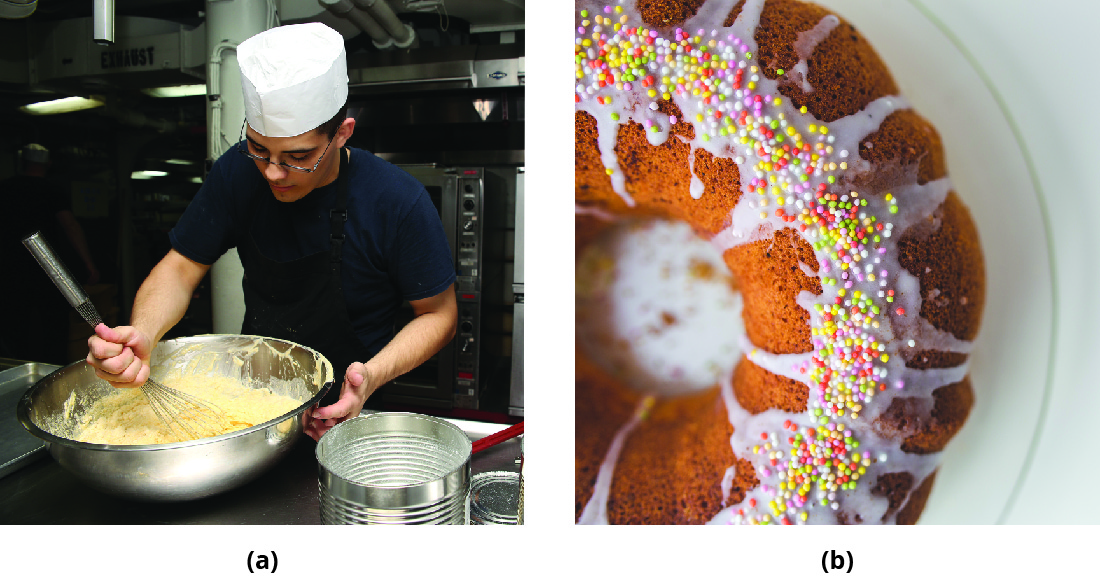
When thinking of the relationship between the elements and the financial statements, nosotros might think of a baking analogy: the elements stand for the ingredients, and the fiscal statements represent the finished product. Equally with baking a cake (encounter (Effigy)), knowing the ingredients (elements) and how each ingredient relates to the final product (financial statements) is vital to the study of accounting.
Baking requires an agreement of the unlike ingredients, how the ingredients are used, and how the ingredients will impact the final product (a). If used correctly, the final product volition be cute and, more importantly, succulent, like the cake shown in (b). In a similar manner, the written report of accounting requires an agreement of how the accounting elements chronicle to the final product—the fiscal statements. (credit (a): modification of "U.Southward. Navy Culinary Specialist Seaman Robert Fritschie mixes cake batter aboard the amphibious command ship USS Blueish Ridge (LCC 19) Aug. 7, 2013, while underway in the Solomon Ocean 130807-North-NN332-044" past MC3 Jarred Harral/Wikimedia Commons, Public Domain; credit (b): modification of "Easter Block with Colorful Topping" by Kaboompics .com/Pexels, CC0)
To help accountants set up and users better understand fiscal statements, the profession has outlined what is referred to equally elements of the fiscal statements, which are those categories or accounts that accountants utilize to record transactions and prepare financial statements. There are ten elements of the fiscal statements, and we have already discussed most of them.
- Revenue—value of goods and services the organization sold or provided.
- Expenses—costs of providing the goods or services for which the organization earns revenue.
- Gains—gains are like to revenue but relate to "incidental or peripheral" activities of the organization.
- Losses—losses are similar to expenses but related to "incidental or peripheral" activities of the arrangement.
- Assets—items the organization owns, controls, or has a claim to.
- Liabilities—amounts the organization owes to others (too chosen creditors).
- Equity—the net worth (or net assets) of the organization.
- Investment by owners—cash or other assets provided to the organization in exchange for an ownership involvement.
- Distribution to owners—cash, other assets, or ownership interest (disinterestedness) provided to owners.
- Comprehensive income—defined every bit the "change in equity of a business organisation enterprise during a flow from transactions and other events and circumstances from nonowner sources" (SFAC No. 6, p. 21). While further discussion of comprehensive income is reserved for intermediate and advanced studies in bookkeeping, it is worth noting that comprehensive income has four components, focusing on activities related to foreign currency, derivatives, investments, and pensions.
Financial Statements for a Sample Visitor
At present information technology is time to bake the cake (i.due east., ready the fiscal statements). We have all of the ingredients (elements of the financial statements) fix, so permit's now render to the financial statements themselves. Allow'south use as an example a fictitious visitor named Cheesy Chuck's Archetype Corn. This company is a small retail store that makes and sells a variety of gourmet popcorn treats. It is an exciting time because the shop opened in the current calendar month, June.
Assume that as part of your summer job with Cheesy Chuck's, the owner—you guessed information technology, Chuck—has asked yous to take over for a onetime employee who graduated higher and will exist taking an accounting job in New York City. In addition to your duties involving making and selling popcorn at Cheesy Chuck's, function of your responsibility will exist doing the bookkeeping for the business. The owner, Chuck, heard that y'all are studying bookkeeping and could really utilize the aid, because he spends most of his fourth dimension developing new popcorn flavors.
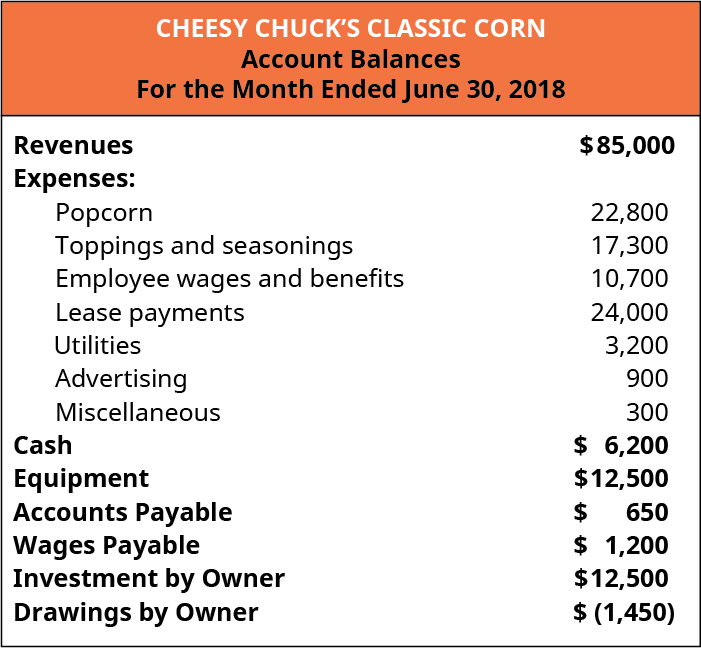
The former employee has done a prissy chore of keeping rails of the accounting records, then you can focus on your starting time job of creating the June financial statements, which Chuck is eager to come across. (Figure) shows the fiscal data (as of June thirty) for Cheesy Chuck's.
Trial Residual for Cheesy Chuck's Archetype Corn. Accountants record and summarize accounting data into accounts, which aid to track, summarize, and prepare accounting data. This table is a variation of what accountants phone call a "trial residual." A trial balance is a summary of accounts and aids accountants in creating financial statements. (attribution: Copyright Rice Academy, OpenStax, nether CC Past-NC-SA 4.0 license)
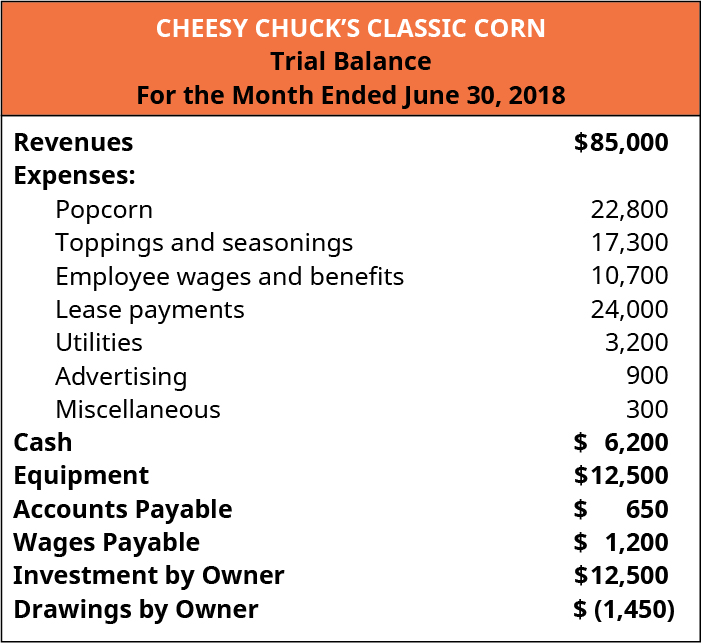
We should note that we are oversimplifying some of the things in this example. Get-go, the amounts in the accounting records were given. We did not explicate how the amounts would exist derived. This process is explained starting in Analyzing and Recording Transactions. Second, we are ignoring the timing of sure greenbacks flows such every bit hiring, purchases, and other startup costs. In reality, businesses must invest cash to prepare the store, train employees, and obtain the equipment and inventory necessary to open. These costs volition precede the selling of appurtenances and services. In the example to follow, for instance, we use Lease payments of ?24,000, which represents charter payments for the building (?20,000) and equipment (?4,000). In practice, when companies lease items, the accountants must decide, based on accounting rules, whether or not the concern "owns" the item. If it is determined the concern "owns" the building or equipment, the detail is listed on the remainder sheet at the original cost. Accountants likewise have into account the edifice or equipment'southward value when the item is worn out. The divergence in these two values (the original cost and the ending value) volition be allocated over a relevant period of time. Every bit an case, assume a business purchased equipment for ?18,000 and the equipment will be worth ?2,000 after four years, giving an estimated turn down in value (due to usage) of ?16,000 (?18,000 − ?2,000). The business concern will allocate ?4,000 of the equipment cost over each of the four years (?xviii,000 minus ?2,000 over 4 years). This is chosen depreciation and is 1 of the topics that is covered in Long-Term Assets.
Likewise, the Equipment with a value of ?12,500 in the financial data provided was purchased at the end of the get-go accounting period. Information technology is an nugget that volition be depreciated in the future, only no depreciation expense is allocated in our example.
Income Statement
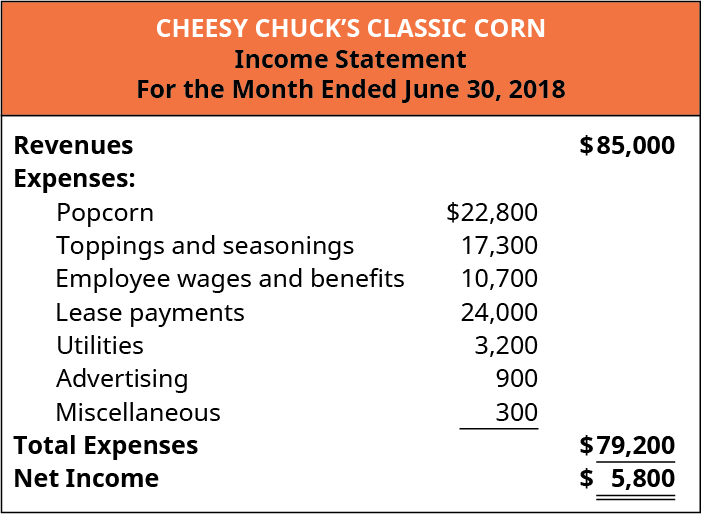
Let's prepare the income statement so nosotros can inform how Cheesy Chuck's performed for the calendar month of June (remember, an income statement is for a period of time). Our first pace is to determine the value of goods and services that the organization sold or provided for a given menstruation of time. These are the inflows to the business concern, and because the inflows relate to the primary purpose of the concern (making and selling popcorn), we classify those items equally Revenues, Sales, or Fees Earned. For this case, we use Acquirement. The revenue for Cheesy Chuck's for the month of June is ?85,000.
Side by side, we need to bear witness the total expenses for Cheesy Chuck'due south. Because Cheesy Chuck'due south tracks different types of expenses, we need to add the amounts to calculate full expenses. If you added correctly, you become total expenses for the month of June of ?79,200. The terminal step to create the income statement is to decide the amount of net income or cyberspace loss for Cheesy Chuck's. Since revenues (?85,000) are greater than expenses (?79,200), Cheesy Chuck'southward has a cyberspace income of ?5,800 for the month of June.
(Figure) displays the June income statement for Cheesy Chuck's Classic Corn.
Income Statement for Cheesy Chuck's Classic Corn. The income statement for Cheesy Chuck's shows the business had Net Income of ?5,800 for the month ended June 30. This amount volition be used to prepare the side by side financial statement, the argument of owner's equity. (attribution: Copyright Rice University, OpenStax, nether CC BY-NC-SA 4.0 license)
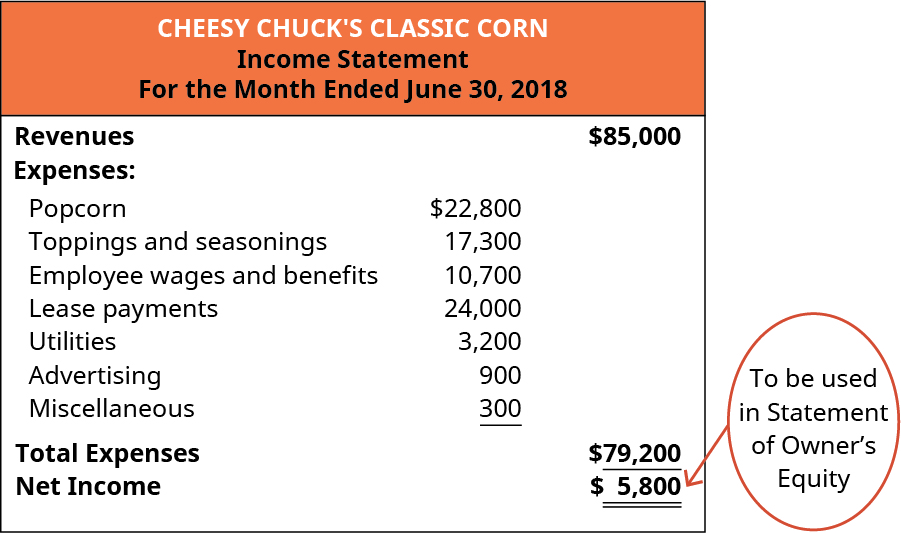
Financial statements are created using numerous standard conventions or practices. The standard conventions provide consistency and help assure financial statement users the information is presented in a similar style, regardless of the organization issuing the financial statement. Permit'south look at the standard conventions shown in the Cheesy Chuck's income statement:
- The heading of the income statement includes iii lines.
- The first line lists the business name.
- The middle line indicates the fiscal statement that is being presented.
- The last line indicates the time frame of the fiscal statement. Do not forget the income statement is for a period of fourth dimension (the calendar month of June in our example).
- There are 3 columns.
- Going from left to correct, the first column is the category heading or business relationship.
- The second column is used when there are numerous accounts in a particular category (Expenses, in our example).
- The tertiary column is a total column. In this illustration, it is the cavalcade where subtotals are listed and internet income is determined (subtracting Expenses from Revenues).
- Subtotals are indicated by a single underline, while totals are indicated by a double underline. Notice the amount of Miscellaneous Expense (?300) is formatted with a unmarried underline to indicate that a subtotal will follow. Similarly, the amount of "Net Income" (?5,800) is formatted with a double underline to bespeak that it is the concluding value/full of the fiscal argument.
- There are no gains or losses for Cheesy Chuck's. Gains and losses are not unusual transactions for businesses, but gains and losses may be infrequent for some, specially small-scale, businesses.
McDonald'due south
For the year concluded Dec 31, 2016, McDonald's had sales of ?24.6 billion.1 The amount of sales is oft used by the business as the starting point for planning the next year. No doubt, at that place are a lot of people involved in the planning for a business the size of McDonald's. Two key people at McDonald's are the purchasing managing director and the sales director (although they might have different titles). Let's look at how McDonald'southward 2016 sales amount might exist used by each of these individuals. In each case, practice non forget that McDonald's is a global company.
A purchasing manager at McDonald's, for case, is responsible for finding suppliers, negotiating costs, arranging for delivery, and many other functions necessary to have the ingredients ready for the stores to set up the food for their customers. Expecting that McDonald's will have over ?24 billion of sales during 2017, how many eggs practice you call up the purchasing manager at McDonald's would need to buy for the year? According to the McDonald'due south website, the company uses over two billion eggs a year.2 Take a moment to list the details that would have to be coordinated in society to buy and deliver over two billion eggs to the many McDonald's restaurants around the earth.
A sales manager is responsible for establishing and attaining sales goals within the company. Assume that McDonald's 2017 sales are expected to exceed the amount of sales in 2016. What conclusions would you lot brand based on this information? What do yous think might be influencing these amounts? What factors do you recollect would be important to the sales managing director in deciding what action, if any, to have? Now assume that McDonald's 2017 sales are expected to be below the 2016 sales level. What conclusions would you make based on this information? What do y'all think might be influencing these amounts? What factors practice you think would be important to the sales manager in deciding what action, if any, to take?
Statement of Owner's Equity
Let'southward create the argument of owner's equity for Cheesy Chuck'south for the month of June. Since Cheesy Chuck's is a brand-new concern, there is no get-go rest of Owner's Disinterestedness. The first items to account for are the increases in value/equity, which are investments by owners and net income. Equally y'all expect at the accounting data you were provided, you lot recognize the amount invested by the owner, Chuck, was ?12,500. Side by side, we business relationship for the increase in value as a event of net income, which was determined in the income statement to be ?5,800. Adjacent, nosotros determine if there were whatever activities that decreased the value of the business. More than specifically, we are accounting for the value of distributions to the owners and cyberspace loss, if whatever.
It is important to note that an organization will have either net income or net loss for the period, merely not both. Also, small businesses in particular may have periods where there are no investments past, or distributions to, the owner(s). For the month of June, Chuck withdrew ?1,450 from the business. This is a good fourth dimension to recall the terminology used past accountants based on the legal construction of the particular business organization. Since the account was titled "Drawings by Owner" and because Chuck is the only owner, we can assume this is a sole proprietorship. If the business was structured every bit a corporation, this action would be called something like "Dividends Paid to Owners."
At this phase, think that since we are working with a sole proprietorship to help simplify the examples, we take addressed the owner's value in the business firm as capital or owner's equity. Nonetheless, afterward we switch the construction of the business to a corporation, and instead of owner's equity, nosotros brainstorm using such account titles as common stock and retained earnings to correspond the owner'southward interests. The corporate treatment is more complicated, because corporations may have a few owners up to potentially thousands of owners (stockholders). The details of bookkeeping for the interests of corporations are covered in Corporation Accounting.
So how much did the value of Cheesy Chuck'south change during the month of June? Yous are right if you answered ?16,850. Since this is a make-new store, the starting time value of the business is nix. During the calendar month, the owner invested ?12,500 and the business had profitable operations (net income) of ?5,800. Besides, during the calendar month the owner withdrew ?1,450, resulting in a net change (and ending residue) to owner's equity of ?16,850. Shown in a formula:
Start Balance + Investments by Owners ± Net Income (Net Loss) – Distributions, or
\(?0+?12,500+?5,800–?i,450=?16,850\)
(Figure) shows what the statement of possessor's equity for Cheesy Chuck's Classic Corn would look similar.
Statement of Owner's Equity for Cheesy Chuck's Archetype Corn. The argument of owner's disinterestedness demonstrates how the net worth (also called equity) of the business organisation changed over the period of time (the month of June in this case). Notice the corporeality of cyberspace income (or cyberspace loss) is brought from the income statement. In a similar manner, the ending equity rest (Capital for Cheesy Chuck'southward because it is a sole proprietorship) is carried frontwards to the balance canvas. (attribution: Copyright Rice University, OpenStax, under CC By-NC-SA four.0 license)
![Cheesy Chuck's Classic Corn, Statement of Owner's Equity, For the month Ended June 30, 2018. Chuck, Capital: June 1, 2018 💲0; Increases: Investments by owner 💲12,500, Net income for the month of june, 2018 [obtained from the income statement] 5,800. Total Increase 18,300. Decreases: Drawings by owner (1,450). Total Decrease (1,450); Chuck, Capital: June 30, 2018 💲16,850 [To be used in Balance Sheet]](https://opentextbc.ca/principlesofaccountingv1openstax/wp-content/uploads/sites/267/2019/07/OSX_Acct_F02_03_ChuckSOE.jpg)
Observe the following about the statement of owner'south equity for Cheesy Chuck's:
- The format is similar to the format of the income statement (three lines for the heading, three columns).
- The statement follows a chronological order, starting with the first day of the month, bookkeeping for the changes that occurred throughout the month, and ending with the last day of the month.
The argument uses the final number from the financial statement previously completed. In this instance, the statement of owner'due south disinterestedness uses the net income (or net loss) amount from the income statement (Cyberspace Income, ?5,800).
Balance Sheet
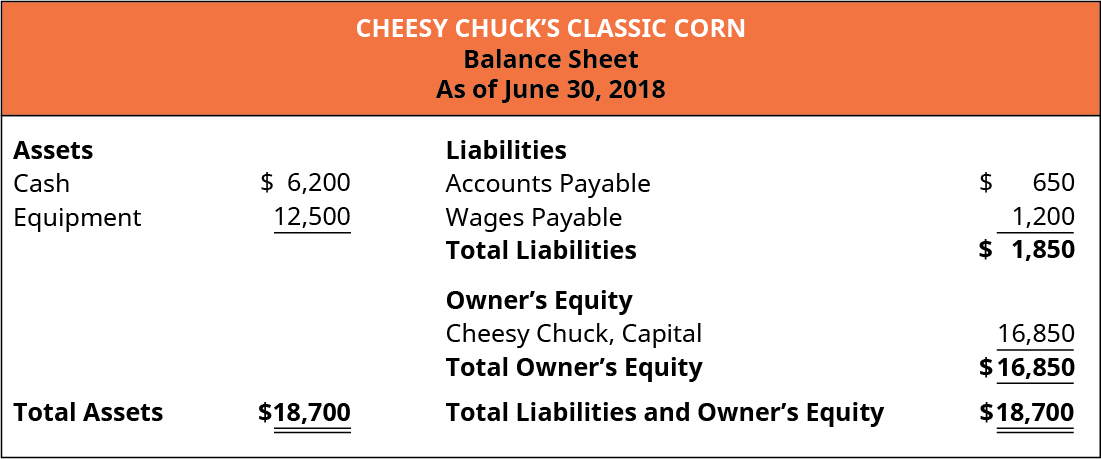
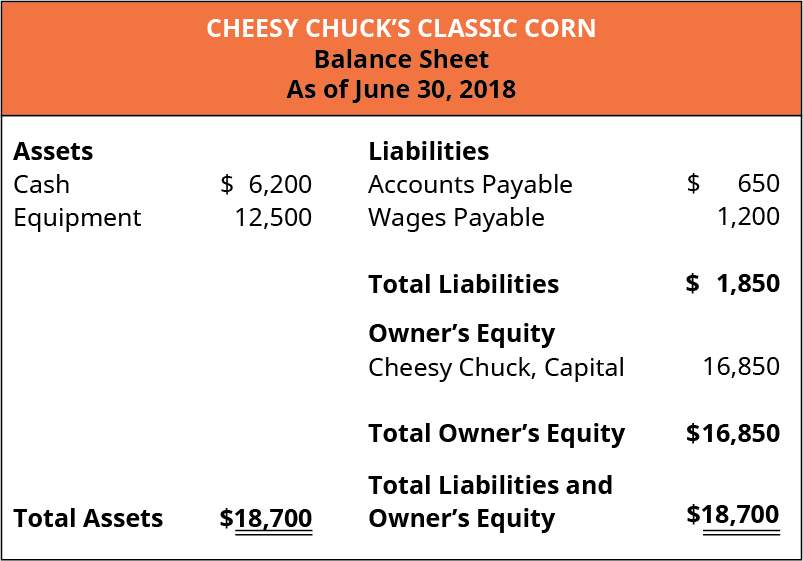
Allow'south create a rest sheet for Cheesy Chuck's for June xxx. To begin, nosotros look at the accounting records and decide what assets the business owns and the value of each. Cheesy Chuck's has two assets: Greenbacks (?6,200) and Equipment (?12,500). Adding the amount of assets gives a total asset value of ?18,700. Every bit discussed previously, the equipment that was recently purchased will be depreciated in the hereafter, beginning with the side by side bookkeeping period.
Next, we make up one's mind the amount of money that Cheesy Chuck'due south owes (liabilities). There are also two liabilities for Cheesy Chuck's. The first account listed in the records is Accounts Payable for ?650. Accounts Payable is the amount that Cheesy Chuck'southward must pay in the time to come to vendors (too called suppliers) for the ingredients to make the gourmet popcorn. The other liability is Wages Payable for ?1,200. This is the amount that Cheesy Chuck's must pay in the future to employees for work that has been performed. Adding the 2 amounts gives usa full liabilities of ?one,850. (Here'due south a hint as you develop your understanding of accounting: Liabilities often include the give-and-take "payable." So, when y'all encounter "payable" in the account title, know these are amounts owed in the future—liabilities.)
Finally, we make up one's mind the amount of equity the owner, Cheesy Chuck, has in the business concern. The corporeality of owner'south disinterestedness was determined on the statement of owner's equity in the previous step (?16,850). Tin you lot call back of some other mode to confirm the amount of owner's equity? Recall that equity is also called net assets (avails minus liabilities). If y'all take the total avails of Cheesy Chuck's of ?18,700 and subtract the total liabilities of ?1,850, you get owner's equity of ?xvi,850. Using the bones accounting equation, the rest sheet for Cheesy Chuck's as of June xxx is shown in (Figure).
Balance Sheet for Cheesy Chuck's Classic Corn. The remainder canvass shows what the business concern owns (Assets), owes (Liabilities), and is worth (equity) on a given engagement. Notice the amount of Owner'southward Equity (Capital letter for Cheesy Chuck's) was brought forrad from the statement of possessor's disinterestedness. (attribution: Copyright Rice University, OpenStax, under CC By-NC-SA iv.0 license)
Connecting the Income Statement and the Balance Sheet
Some other style to think of the connection between the income argument and balance canvas (which is aided by the statement of owner's equity) is past using a sports illustration. The income statement summarizes the fiscal performance of the business concern for a given menstruum of time. The income argument reports how the business performed financially each month—the firm earned either cyberspace income or net loss. This is similar to the outcome of a particular game—the team either won or lost.
The balance canvas summarizes the financial position of the business on a given date. Meaning, considering of the financial performance over the past twelve months, for example, this is the fiscal position of the business every bit of December 31. Think of the remainder sheet every bit being similar to a team's overall win/loss record—to a certain extent a squad's strength tin can be perceived by its win/loss record.
Withal, because different companies have different sizes, yous practice not necessarily want to compare the balance sheets of two different companies. For example, you would not desire to compare a local retail store with Walmart. In near cases you want to compare a company with its past balance canvass data.
Creating Financial Statements: A Summary
In this example using a fictitious company, Cheesy Chuck's, we began with the account balances and demonstrated how to ready the fiscal statements for the month of June, the outset calendar month of operations for the business. Information technology will exist helpful to revisit the process by summarizing the information we started with and how that data was used to create the iv financial statements: income statement, statement of owner's equity, balance sheet, and statement of cash flows.
Nosotros started with the business relationship balances shown in (Figure).
Account Balances for Cheesy Chuck'southward Classic Corn. Obtaining the account balances is the starting signal for preparing financial statements. (attribution: Copyright Rice Academy, OpenStax, under CC Past-NC-SA 4.0 license)
The side by side step was to create the income statement, which shows the fiscal performance of the business. The income statement is shown in (Figure).
Income Argument for Cheesy Chuck'southward Classic Corn. The income statement uses data from the trial remainder, which lists the accounts and account totals. The income statement shows the financial performance of a business organization for a menses of time. The internet income or net loss will be carried forrard to the statement of owner's equity. (attribution: Copyright Rice University, OpenStax, nether CC BY-NC-SA 4.0 license)
Next, we created the statement of owner'south equity, shown in (Figure). The statement of owner'due south equity demonstrates how the equity (or net worth) of the business inverse for the calendar month of June. Exercise not forget that the Net Income (or Net Loss) is carried frontwards to the statement of owner'southward disinterestedness.
Statement of Owner'south Equity for Cheesy Chuck'due south Classic Corn. The statement of owner's equity shows how the net worth/value (or disinterestedness) of business changed for the flow of time. This statement includes Net Income (or Net Loss), which was brought frontwards from the income statement. The catastrophe balance is carried forward to the residue sail. (attribution: Copyright Rice University, OpenStax, nether CC BY-NC-SA four.0 license)
![Cheesy Chuck's Classic Corn, Statement of Owner's Equity, For the month Ended June 30, 2018. Chuck, Capital: June 1, 2018 💲0; Increases: Investments by owner 💲12,500, Net income for the month of june, 2018 [obtained from the income statement] 5,800. Total Increase 18,300. Decreases: Drawings by owner (1,450). Total Decrease (1,450); Chuck, Capital: June 30, 2018 💲16,850 [To be used in Balance Sheet].](https://opentextbc.ca/principlesofaccountingv1openstax/wp-content/uploads/sites/267/2019/07/OSX_Acct_F02_03_ChuckSum03.jpg)
The 3rd financial statement created is the balance canvas, which shows the company's financial position on a given date. Cheesy Chuck'due south balance sheet is shown in (Effigy).
Residual Sheet for Cheesy Chuck's Classic Corn. The remainder sheet shows the assets, liabilities, and owner'south equity of a business on a given date. Find the balance sheet is the accounting equation in financial statement grade: Assets = Liabilities + Owner's Equity. (attribution: Copyright Rice University, OpenStax, under CC By-NC-SA 4.0 license)
Financial Statement Assay
In Why It Matters, we pointed out that accounting data from the financial statements can be useful to business concern owners. The financial statements provide feedback to the owners regarding the financial operation and financial position of the business, helping the owners to brand decisions about the business.
Using the June financial statements, analyze Cheesy Chuck's and prepare a brief presentation. Consider this from the perspective of the owner, Chuck. Describe the fiscal functioning of and fiscal position of the business organisation. What areas of the business would you want to analyze farther to become additional information? What changes would you consider making to the business, if any, and why or why not?
Financial Statement Manipulation at Waste Management Inc.
Accountants take an ethical duty to accurately report the financial results of their visitor and to ensure that the company'south annual reports communicate relevant information to stakeholders. If accountants and company direction neglect to do then, they may incur heavy penalties.
For instance, in 2002 the Securities and Exchange Commission (SEC) charged the top management of Waste product Direction, Inc. with inflating profits by ?1.vii billion to run into earnings targets in the period 1992–1997. An SEC printing release declared "that defendants fraudulently manipulated the company's fiscal results to come across predetermined earnings targets. . . . They employed a multitude of improper accounting practices to accomplish this objective."3 The defendants in the case manipulated reports to defer or eliminate expenses, which fraudulently inflated their earnings. Because they failed to accurately study the fiscal results of their visitor, the top accountants and management of Waste Direction, Inc. face charges.
Thomas C. Newkirk, the associate director of the SEC'south Division of Enforcement, stated, "For years, these defendants cooked the books, enriched themselves, preserved their jobs, and duped unsuspecting shareholders"4 The defendants, who included members of the company board and executives, benefited personally from their fraud in the millions of dollars through performance-based bonuses, charitable giving, and auction of company stock. The company's bookkeeping form, Arthur Andersen, abetted the fraud by identifying the improper practices but doing little to stop them.
Liquidity Ratios
In addition to reviewing the financial statements in gild to make decisions, owners and other stakeholders may also utilize fiscal ratios to assess the financial health of the arrangement. While a more than in-depth discussion of financial ratios occurs in Appendix A: Financial Argument Analysis, here we introduce liquidity ratios, a common, easy, and useful way to clarify the financial statements.
Liquidity refers to the business's ability to catechumen assets into cash in guild to run into short-term greenbacks needs. Examples of the almost liquid avails include accounts receivable and inventory for merchandising or manufacturing businesses. The reason these are among the most liquid assets is that these assets volition be turned into cash more apace than land or buildings, for example. Accounts receivable represents goods or services that have already been sold and will typically be paid/collected within thirty to 40-5 days. Inventory is less liquid than accounts receivable considering the production must first exist sold before it generates greenbacks (either through a cash sale or sale on account). Inventory is, however, more liquid than land or buildings because, under nigh circumstances, it is easier and quicker for a business to detect someone to purchase its goods than it is to discover a buyer for land or buildings.
Working Capital
The starting signal for understanding liquidity ratios is to define working capital—current assets minus current liabilities. Recall that electric current assets and current liabilities are amounts mostly settled in i year or less. Working capital (current assets minus current liabilities) is used to assess the dollar amount of assets a business has available to meet its short-term liabilities. A positive working capital amount is desirable and indicates the business has sufficient electric current assets to meet short-term obligations (liabilities) and still has financial flexibility. A negative amount is undesirable and indicates the concern should pay particular attention to the composition of the current assets (that is, how liquid the current avails are) and to the timing of the electric current liabilities. Information technology is unlikely that all of the current liabilities will be due at the same time, merely the amount of working capital gives stakeholders of both modest and large businesses an indication of the business firm's ability to meet its short-term obligations.
One limitation of working capital is that information technology is a dollar corporeality, which can be misleading because business sizes vary. Recall from the word on materiality that ?1,000, for example, is more than cloth to a small concern (similar an independent local movie theater) than it is to a large business organisation (similar a picture show theater chain). Using percentages or ratios allows financial statement users to more hands compare small and big businesses.
Current Ratio
The current ratio is closely related to working capital; it represents the current assets divided by electric current liabilities. The current ratio utilizes the same amounts as working capital (electric current assets and electric current liabilities) just presents the amount in ratio, rather than dollar, form. That is, the electric current ratio is defined as current avails/current liabilities. The interpretation of the current ratio is similar to working capital. A ratio of greater than one indicates that the firm has the power to run across short-term obligations with a buffer, while a ratio of less than i indicates that the house should pay close attention to the limerick of its current assets as well equally the timing of the current liabilities.
Sample Working Uppercase and Current Ratio Calculations
Assume that Chuck, the owner of Cheesy Chuck's, wants to assess the liquidity of the business organization. (Figure) shows the June xxx, 2018, balance sheet. Assume the Equipment listed on the balance sheet is a noncurrent asset. This is a reasonable assumption as this is the first month of operation and the equipment is expected to final several years. We also assume the Accounts Payable and Wages Payable will exist paid within i year and are, therefore, classified every bit electric current liabilities.
Balance Sheet for Cheesy Chuck'due south Classic Corn. The balance canvass provides a snapshot of the company'southward financial position. By showing the total avails, total liabilities, and total equity of the business, the rest canvas provides information that is useful for decision-making. In add-on, using ratios can give stakeholders another view of the company, assuasive for comparisons to prior periods and to other businesses. (attribution: Copyright Rice University, OpenStax, under CC BY-NC-SA 4.0 license)
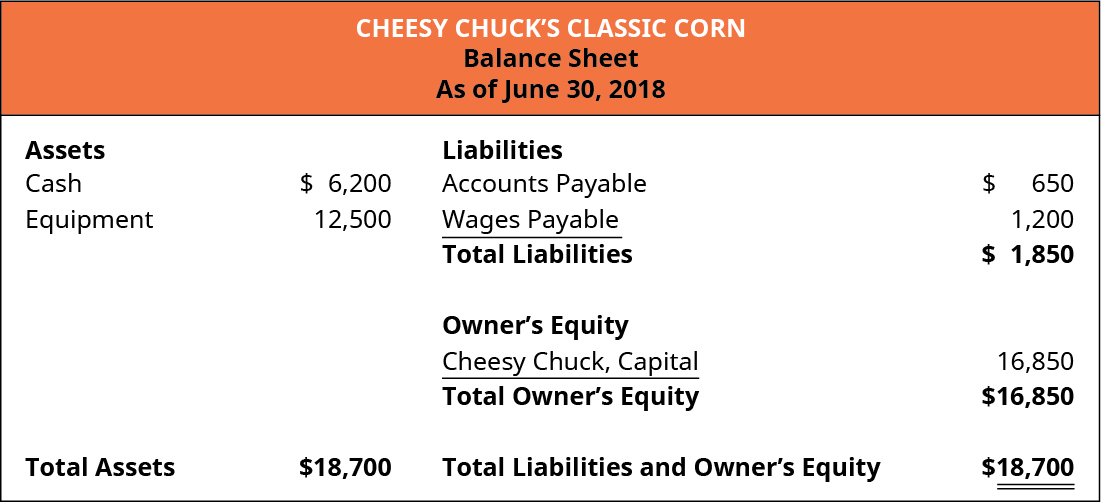
Working uppercase is calculated equally electric current avails minus current liabilities. Cheesy Chuck's has only ii avails, and i of the avails, Equipment, is a noncurrent asset, and then the value of current assets is the cash amount of ?6,200. The working capital of Cheesy Chuck's is ?6,200 – ?ane,850 or ?4,350. Since this amount is over ?0 (it is well over ?0 in this case), Chuck is confident he has nothing to worry almost regarding the liquidity of his business.
Let's further presume that Chuck, while attending a popcorn conference for store owners, has a chat with the owner of a much larger popcorn store—Captain Caramel'south. The owner of Captain Caramel's happens to share the working majuscule for his store is ?52,500. At showtime Chuck feels his business is not doing and so well. Merely and so he realizes that Captain Caramel'southward is located in a much bigger city (with more customers) and has been around for many years, which has allowed them to build a solid business, which Chuck aspires to do. How would Chuck compare the liquidity of his new business organization, opened just one month, with the liquidity of a larger and more-established concern in some other market place? The answer is past calculating the current ratio, which removes the size differences (materiality) of the ii businesses.
The current ratio is calculated equally current assets/electric current liabilities. Nosotros use the same amounts that we used in the working capital calculation, just this time we separate the amounts rather than subtract the amounts. Then Cheesy Chuck'south current ratio is ?6,200 (current avails)/?1,850 (current liabilities), or 3.35. This means that for every dollar of current liabilities, Cheesy Chuck'southward has ?3.35 of current assets. Chuck is pleased with the ratio merely does not know how this compares to another popcorn store, and so he asked his new friend from Captain Caramel's. The possessor of Captain Caramel's shares that his store has a current ratio of four.25. While it is still meliorate than Cheesy Chuck's, Chuck is encouraged to acquire that his shop is performing at a more than competitive level than he previously idea by comparing the dollar amounts of working capital.
IFRS and US GAAP in Financial Statements
Understanding the elements that make upwardly financial statements, the organization of those elements within the fiscal statements, and what information each statement relays is important, whether analyzing the financial statements of a US company or 1 from Republic of honduras. Since about US companies apply generally accustomed bookkeeping principles (GAAP)5 as prescribed past the Financial Accounting Standards Board (FASB), and nearly international companies apply some version of the International Financial Reporting Standards (IFRS),six knowing how these two sets of accounting standards are similar or different regarding the elements of the fiscal statements volition facilitate assay and decision-making.
Both IFRS and United states GAAP have the same elements as components of fiscal statements: assets, liabilities, disinterestedness, income, and expenses. Equity, income, and expenses take like subcategorization between the ii types of GAAP (United states of america GAAP and IFRS) equally described. For example, income can be in the form of earned income (a lawyer providing legal services) or in the form of gains (involvement earned on an investment account). The definition of each of these elements is similar between IFRS and US GAAP, but there are some differences that can influence the value of the account or the placement of the account on the financial statements. Many of these differences are discussed in detail afterward in this form when that chemical element—for example, the nuances of accounting for liabilities—is discussed. Hither is an instance to illustrate how these minor differences in definition can impact placement inside the fiscal statements when using Usa GAAP versus IFRS. Top Car Rental Company typically rents its cars for a time of ii years or 60,000 miles. At the end of whichever of these two measures occurs first, the cars are sold. Under both US GAAP and IFRS, the cars are noncurrent avails during the menstruum when they are rented. Once the cars are being "held for sale," nether IFRS rules, the cars become electric current assets. All the same, under US GAAP, there is no specific dominion as to where to list those "held for auction" cars; thus, they could however list the cars every bit noncurrent avails. As you larn more about the analysis of companies and financial information, this difference in placement on the financial statements will become more meaningful. At this point, simply know that financial analysis can include ratios, which is the comparison of ii numbers, and thus whatever time y'all change the denominator or the numerator, the ratio result volition alter.
At that place are many similarities and some differences in the actual presentation of the diverse financial statements, but these are discussed in The Adjustment Process at which point these similarities and differences will be more meaningful and easier to follow.
Central Concepts and Summary
- There are x fiscal argument elements: revenues, expenses, gains, losses, avails, liabilities, disinterestedness, investments past owners, distributions to owners, and comprehensive income.
- At that place are standard conventions for the order of preparing financial statements (income statement, argument of owner's equity, balance sail, and statement of greenbacks flows) and for the format (three-line heading and columnar structure).
- Financial ratios, which are calculated using financial argument data, are often beneficial to aid in financial decision-making. Ratios allow for comparisons betwixt businesses and determining trends betwixt periods within the same business.
- Liquidity ratios assess the firm'due south ability to convert avails into cash.
- Working Capital (Current Avails – Current Liabilities) is a liquidity ratio that measures a business firm'due south ability to meet current obligations.
- The Current Ratio (Current Assets/Current Liabilities) is like to Working Capital but allows for comparisons between firms by determining the proportion of current avails to electric current liabilities.
Multiple Selection
(Figure)Which of the following is non an element of the financial statements?
- future potential sales price of inventory
- assets
- liabilities
- disinterestedness
(Figure)Which of the following is the right gild of preparing the fiscal statements?
- income statement, statement of cash flows, residue canvass, statement of owner's equity
- income statement, statement of owner's equity, residual canvas, statement of cash flows
- income statement, balance canvas, statement of possessor's equity, statement of cash flows
- income statement, balance sheet, statement of cash flows, statement of possessor's equity
B
(Figure)The three heading lines of fiscal statements typically include which of the following?
- company, statement title, time flow of report
- visitor headquarters, statement title, name of preparer
- statement championship, time catamenia of written report, name of preparer
- name of auditor, statement title, fiscal year finish
(Effigy)Which financial statement shows the financial performance of the visitor on a cash basis?
- balance sheet
- statement of possessor'due south disinterestedness
- statement of cash flows
- income statement
C
(Figure)Which financial statement shows the financial position of the company?
- balance sheet
- statement of owner's equity
- statement of greenbacks flows
- income statement
(Figure)Working capital is an indication of the firm's ________.
- asset utilization
- corporeality of noncurrent liabilities
- liquidity
- amount of noncurrent assets
C
Questions
(Figure)Identify the order in which the four fiscal statements are prepared, and explain how the first three statements are interrelated.
(Effigy)Explain how the following items touch on equity: revenue, expenses, investments by owners, and distributions to owners.
Revenues and investments increment equity, while expenses and distributions subtract disinterestedness.
(Effigy)Explain the purpose of the argument of cash flows and why this argument is needed.
Practise Ready A
(Figure)Gear up an income statement using the post-obit information for DL Enterprises for the month of July 2018.
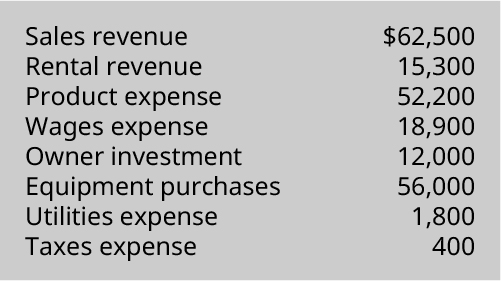
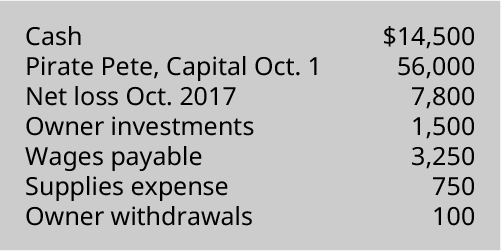
(Effigy)Prepare a statement of owner's equity using the information provided for Pirate Landing for the month of October 2018.
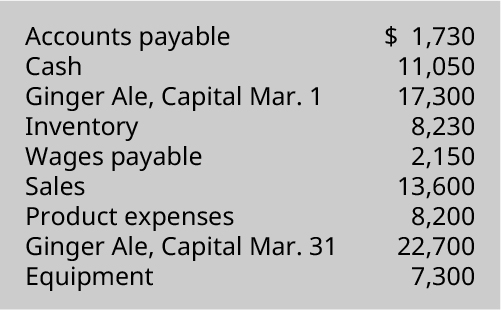
(Figure)Prepare a balance sail using the following data for the Ginger Company as of March 31, 2019.
Do Set up B
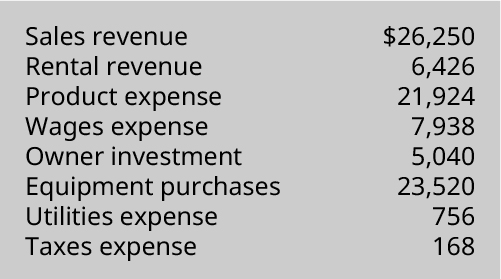
(Effigy)Ready an income statement using the following information for CK Company for the calendar month of February 2019.
(Figure)Prepare a statement of owner's equity using the following data for the Tin can Due Shop for the month of September 2018.
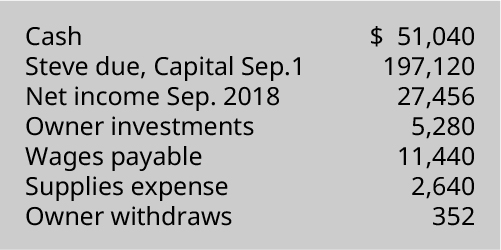
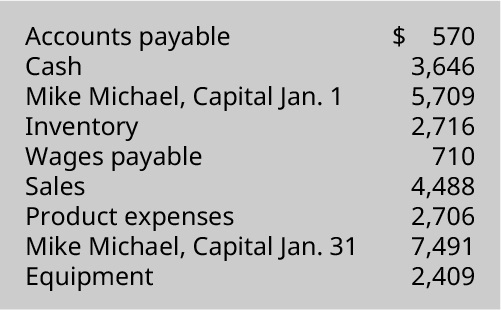
(Figure)Ready a rest canvass using the following information for Mike's Consulting as of January 31, 2019.
Trouble Set A
(Figure)The post-obit ten transactions occurred during the July grand opening of the Pancake Palace. Presume all Retained Earnings transactions chronicle to the main purpose of the business.
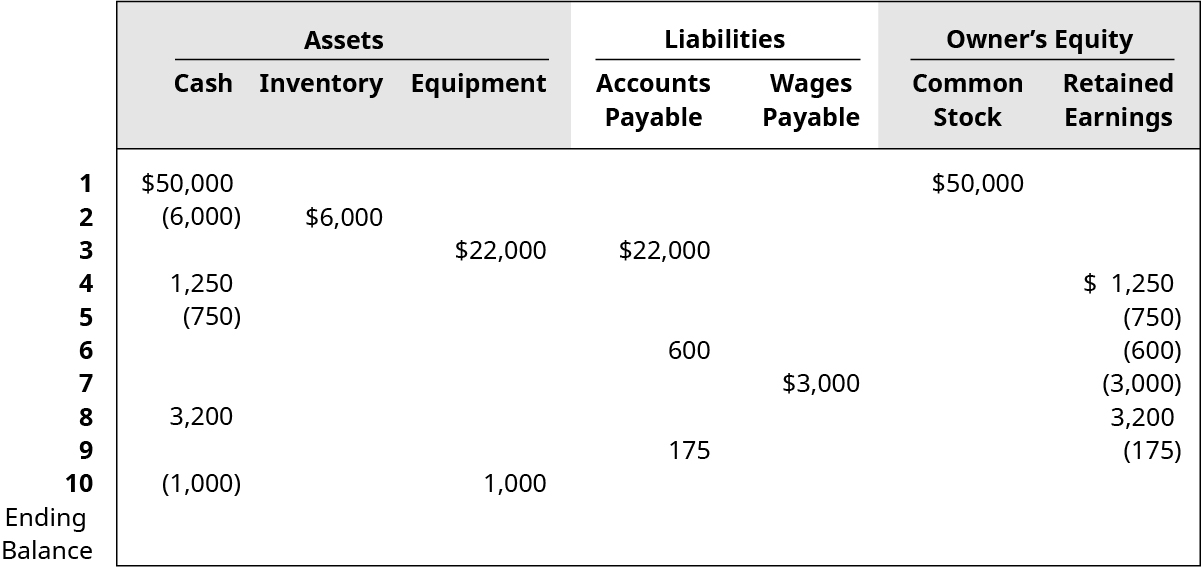
- Calculate the ending balance for each account.
- Create the income statement.
- Create the statement of owner'due south disinterestedness.
- Create the balance sheet.
Idea Provokers
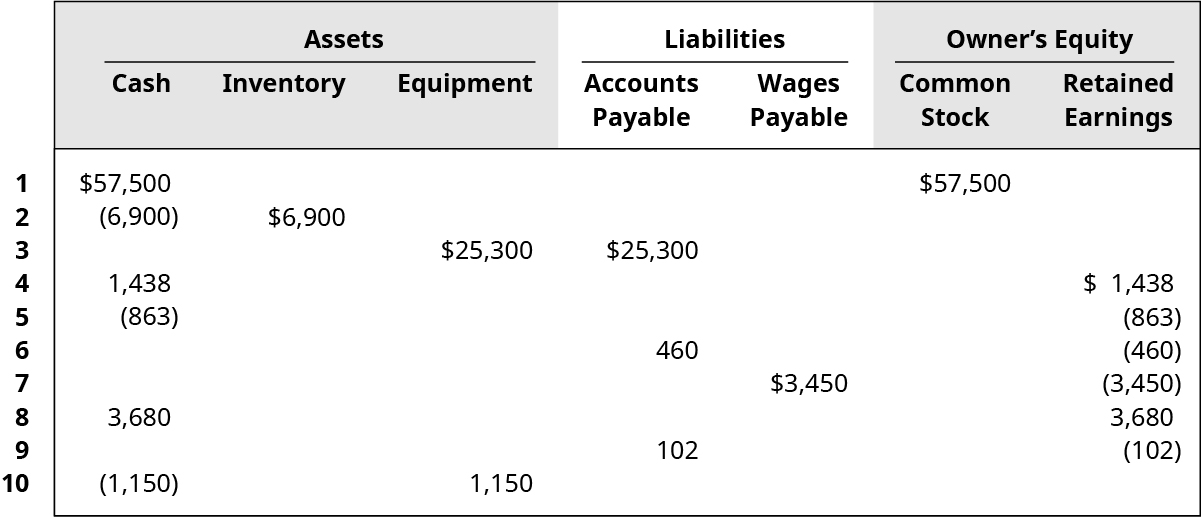
(Figure)For each of the following x independent transactions, provide a written description of what occurred in each transaction. (Figure) might aid you.
(Effigy)The following historical information is from Assisi Community Markets.
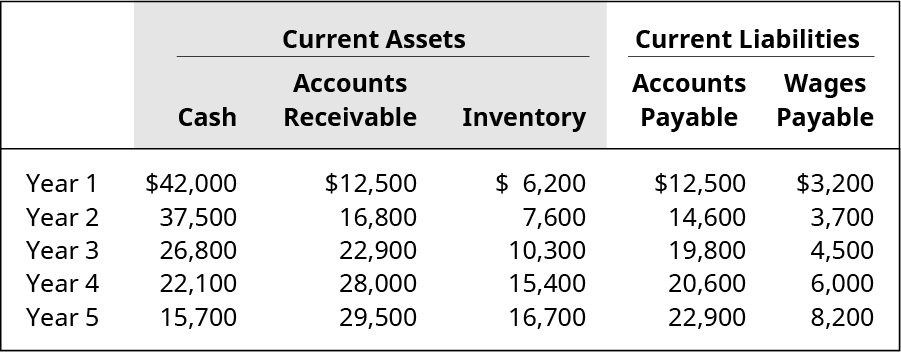
Calculate the working capital and electric current ratio for each twelvemonth. What observations do you make, and what actions might the owner consider taking?
Footnotes
- oneMcDonald's Corporation. U.S. Securities and Exchange Committee 10-K Filing. March 1, 2017. http://d18rn0p25nwr6d.cloudfront.net/CIK-0000063908/62200c2b-da82-4364-be92-79ed454e3b88.pdf
- twoMcDonald'due south. "Our Nutrient. Your Questions. Breakfast." northward.d. https://www.mcdonalds.com/u.s./en-us/well-nigh-our-nutrient/our-food-your-questions/breakfast.html
- 3U.S. Securities and Commutation Commission. "Waste Management Founder, 5 Other Erstwhile Meridian Officers Sued for Massive Fraud." March 26, 2002. https://www.sec.gov/news/headlines/wastemgmt6.htm
- 4U.Southward. Securities and Substitution Commission. "Waste Direction Founder, Five Other Old Top Officers Sued for Massive Fraud." March 26, 2002. https://www.sec.gov/news/headlines/wastemgmt6.htm
- vPublicly traded companies in the United States must file their fiscal statements with the SEC, and those statements must be compiled using US GAAP. However, in some states, private companies can employ IFRS for SMEs (small and medium entities).
- 6The following site identifies which countries require IFRS, which use a modified version of IFRS, and which countries prohibit the use of IFRS. https://www.iasplus.com/en/resources/ifrs-topics/use-of-ifrs
Glossary
- comprehensive income
- change in disinterestedness of a business enterprise during a period from transactions and other events and circumstances from nonowner sources
- current ratio
- current avails divided past current liabilities; used to determine a visitor's liquidity (ability to meet short-term obligations)
- elements of the fiscal statements
- categories or groupings used to record transactions and fix financial statements
- liquidity
- power to convert assets into cash in order to meet primarily brusk-term cash needs or emergencies
- working capital letter
- current avails less current liabilities; sometimes used equally a measure of liquidity

Source: https://opentextbc.ca/principlesofaccountingv1openstax/chapter/prepare-an-income-statement-statement-of-owners-equity-and-balance-sheet/
Posted by: collinshickinurpoll.blogspot.com
0 Response to "Should I Manually Adjust Shareholder Draws Account And Owner's Equity Account At End Of Year"
Post a Comment